
THE FOREST PANTRY: WILD INGREDIENTS TO KNOW – ALU LEAVES
Alu Leaves — The Leaf Behind India’s Patra
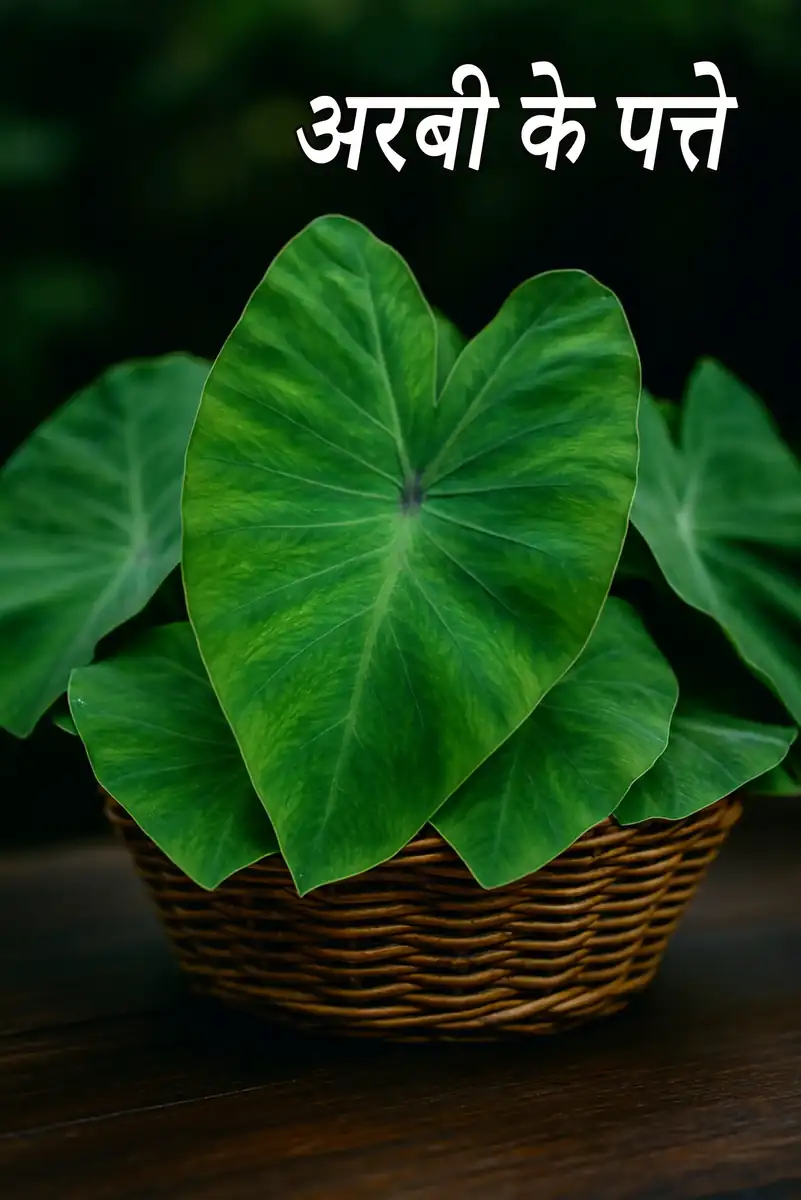
Walk through an Indian vegetable market during the monsoon, and you may come across large, heart-shaped green leaves that are difficult to miss.
Known by names such as alu, arbi, kachu and chema, these are the leaves of Colocasia esculenta, commonly known as taro or colocasia.
For many of us, the plant is better known for its starchy underground corm—the familiar arbi. But the leaves have an identity of their own. Across India, they are steamed, rolled, stuffed, fried, cooked into curries and even used as natural wrappers for food.
What looks like an ordinary green leaf carries something much more interesting: seasonality, traditional knowledge, food safety and cultural identity.
And the more I began looking at traditional and forest foods, the more I realised that a leaf like this is rarely just a leaf.

GETTING TO KNOW THE ALU PLANT
Colocasia esculenta belongs to the Araceae family and is widely cultivated across tropical and subtropical regions.
In India, the plant is known by different regional names and is grown across diverse parts of the country. FSSAI documents the traditional use of colocasia leaves in states including Assam, Manipur, Mizoram, Maharashtra, Gujarat, Kerala, Tamil Nadu, Andhra Pradesh, Telangana, West Bengal, Bihar, Odisha and Uttarakhand.
The plant is valued for more than one edible part. Its corms and cormels are eaten as vegetables, while the tender leaves and stalks are used in a variety of traditional preparations.
The leaves are particularly interesting because of their broad surface. They can be rolled, wrapped, layered and steamed, allowing the leaf itself to become part of the cooking process.
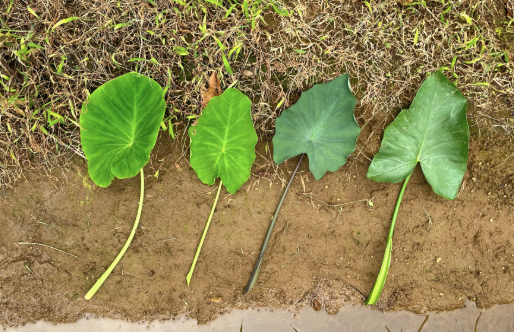
FOUR TYPES AND FORMS OF COLOCASIA
Colocasia is not one completely uniform plant. Different varieties and locally maintained types can differ in leaf size, shape, colour, petiole characteristics, maturity and cooking qualities.
1. Narendra Bunda-1
An improved Colocasia esculenta variety developed in India. It has upright green leaves, with purple streaking on the veins and petioles. It is suitable for both summer and rainy-season cultivation and has been noted for relatively low acridity and easy cooking.
2. Megha Taro-3
A colocasia variety developed for the North-Eastern Hill region of India, reflecting the importance of taro in the region’s agricultural and food systems.
3. Bunda Types
Bunda refers to traditional taro types found in Indian agricultural and food systems. ICAR records collections of Colocasia esculenta that include taro, bunda and swamp-taro types.
4. Swamp-Taro Types
Swamp-taro represents colocasia types adapted to wetter growing conditions, forming part of the wider diversity maintained within Colocasia esculenta.
One important thing to remember is that local names and classifications can vary considerably between regions. These names should therefore not automatically be treated as four completely separate botanical species or varieties.
WHEN AND WHERE DOES ALU GROW?
Alu thrives in warm and moist conditions, making the monsoon particularly important for its growth.
Depending on the variety, location and cultivation system, colocasia can be grown during different parts of the year. The plant’s relationship with moisture is also reflected in traditional food cultures, where seasonal greens often become available when they grow naturally and abundantly.
This is one of the principles I keep coming back to while exploring the forest pantry:
Eat with the seasons. Understand the landscape. And pay attention to what grows naturally around you.
FROM LEAF TO PLATE
The leaves are generally harvested when they are young and tender.
Their broad surface makes them particularly useful for preparations where ingredients are rolled, layered or wrapped.
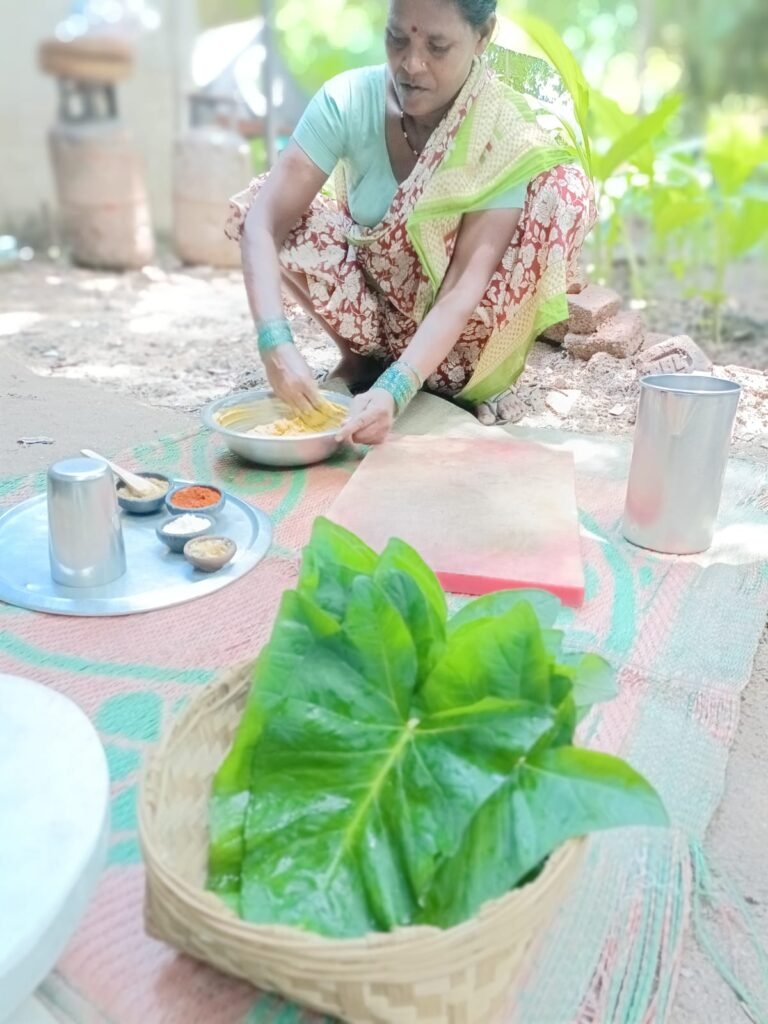
One of the best-known examples is Patra or Alu Vadi—colocasia leaves layered with a spiced gram-flour mixture, rolled, steamed and sliced. Depending on the region, the pieces may then be tempered or fried.
But Patra is only one expression of the leaf.
Across India, colocasia leaves and stalks appear in steamed dishes, curries, fritters, stuffed preparations and wrapped foods. FSSAI also records their use as food wraps for both steam cooking and oil frying.
The leaf, therefore, becomes more than an ingredient.
It becomes part of the cooking technique itself.
WHY CAN’T WE EAT ALU LEAVES RAW?
This is perhaps the most important thing to know about colocasia leaves.
Colocasia naturally contains calcium oxalate crystals known as raphides. These tiny needle-like crystals can cause an irritating or prickling sensation in the mouth and throat when the leaves are eaten raw or inadequately prepared.
This is why traditional cooking methods are not simply about flavour.
They are also about making the ingredient suitable for consumption.
FSSAI notes the traditional practice of boiling or steaming colocasia leaves with tamarind, owing to their calcium oxalate content.
So when a traditional recipe tells you to steam the leaves thoroughly or combine them with a souring ingredient, it is worth paying attention.
What may look like a simple cooking instruction can actually carry generations of practical knowledge.
PREPARING ALU LEAVES SAFELY
When cooking with colocasia leaves:
-
- Choose fresh, healthy and tender leaves.
-
- Wash them thoroughly and remove damaged portions.
-
- Follow a tested traditional cooking method.
-
- Cook the leaves thoroughly rather than consuming them raw.
-
- Traditional preparations may use tamarind or other souring ingredients.
-
- Do not assume that every large, taro-like leaf is automatically safe to eat.
The safest approach is simple:
Identify the plant correctly and follow an established preparation method.
TRADITIONAL DISHES MADE WITH ALU LEAVES
Patra / Alu Vadi
Colocasia leaves layered with spiced gram flour, rolled, steamed and sliced before being tempered or fried.
Alu Pitha
A regional preparation where colocasia leaves are incorporated into a traditional steamed or cooked preparation, with variations across communities.
Alu Leaf Curries
Tender leaves and stalks are cooked with spices, pulses or souring ingredients to create regional vegetable preparations.
Stuffed and Wrapped Preparations
The broad leaves can be used to wrap other ingredients before steaming or cooking, allowing the leaf itself to become part of the dish.
These preparations demonstrate an important principle of traditional cuisine: the cooking method is often as important as the ingredient.
THE LEAF I STARTED SEEING DIFFERENTLY
My relationship with ingredients like alu changed when I began spending time around tribal and indigenous communities and listening to the way they spoke about food.
In these interactions, I found myself looking at food very differently.
A recipe was rarely just a recipe.
There was usually a story before the recipe—a story about where something grew, when it appeared, which part was harvested, how it was processed and why it was cooked in a particular way.
Sometimes, the most valuable part of a conversation wasn’t a written recipe at all. It was a small observation casually shared by someone who had grown up around the ingredient.
That is when I started understanding why documenting traditional food can be so important.
Much of this knowledge doesn’t necessarily live in cookbooks.
It lives with people.
DISCOVERING ALU BEYOND PATRA
Before exploring these food traditions more closely, I mostly associated colocasia leaves with the familiar Patra or Alu Vadi.
But while interacting with different communities and exploring regional food practices, I began encountering the leaf in a much wider culinary context.
The same broad green leaf could become a wrapper, a steamed preparation, a curry or part of a stuffed dish.
And that fascinated me.
The ingredient hadn’t changed.
The landscape, community and culinary knowledge around it had.
This became one of the most interesting things about researching traditional foods for me: one ingredient can have many identities.
A dish that may seem unusual to someone encountering it for the first time can be completely ordinary—and deeply familiar—to the community that has cooked it for generations.

RECIPES ARE ALSO RECORDS OF A LANDSCAPE
While documenting food traditions, I began paying attention not only to what people cooked, but also to why they cooked it that way.
Why was the leaf steamed rather than eaten raw?
Why was a souring ingredient added?
Why was one part of the plant harvested while another was left alone?
Why was a particular preparation associated with a particular season?
These questions made me realise that traditional food knowledge is almost like a living record of the landscape.
The recipes tell us about availability, seasonality, agriculture, preservation and adaptation.
And sometimes they tell us about something even more important: how closely people have observed the plants around them.
THE MANY LIVES OF ONE LEAF
What I find most fascinating about alu leaves is how easily they move between different culinary roles.
In one kitchen, they may be carefully layered with gram flour and rolled into Patra.
Somewhere else, they may be cooked with other ingredients as a vegetable.
Elsewhere, the leaf itself may become a wrapper or part of a steamed preparation.
The more I explored these variations, the more I stopped thinking of Patra as the colocasia-leaf dish.
It is simply one chapter in a much larger story.
And that, for me, is what makes documenting traditional and forest foods so rewarding.
The objective isn’t always to discover something completely new.
Sometimes, it is simply to look again at something familiar and understand it more deeply.
WHAT MY INTERACTIONS WITH COMMUNITIES TAUGHT ME
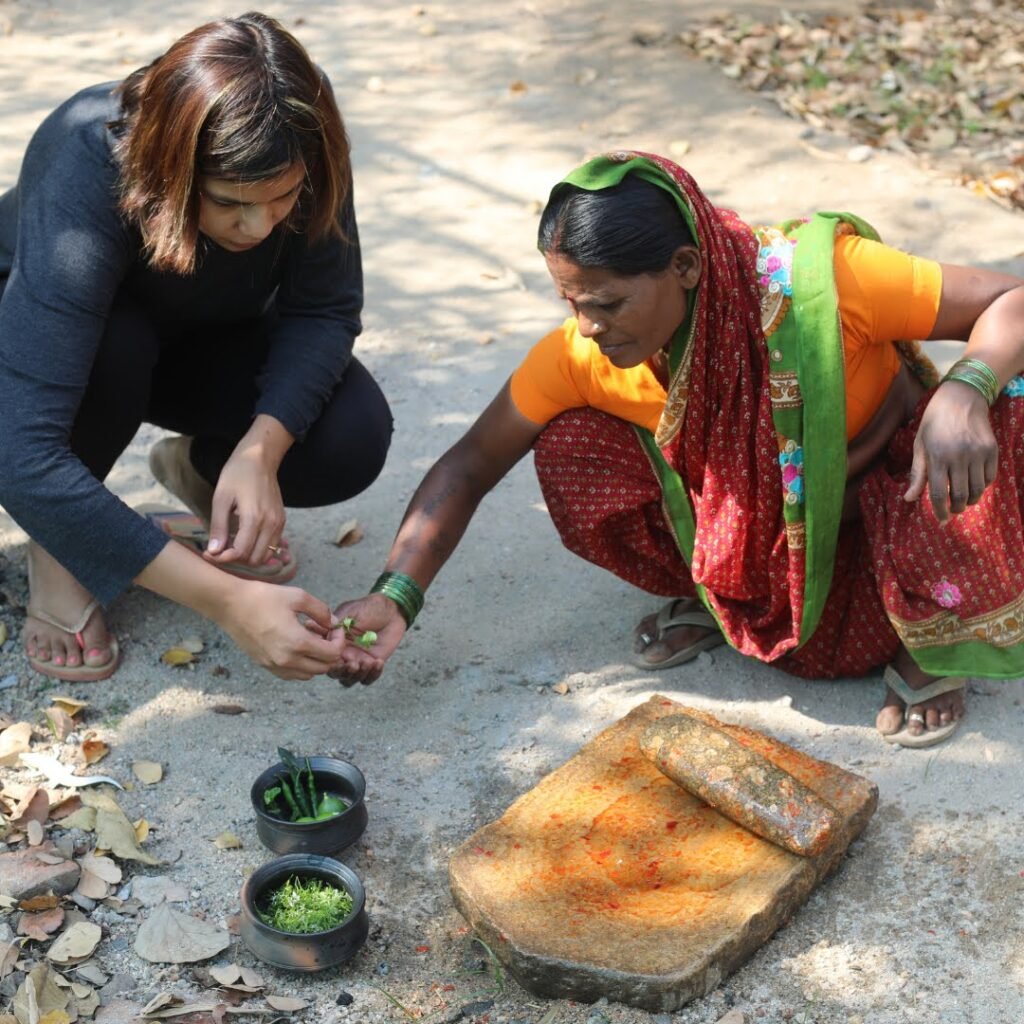
My conversations and interactions with tribal communities have repeatedly reminded me that culinary knowledge is deeply connected to place.
People who live close to forests, fields and seasonal landscapes develop an intimate understanding of what surrounds them.
They know when something appears.
They know when it is young enough to harvest.
They know which parts are edible.
They know how it needs to be processed.
And they know how to turn it into something worth eating.
This knowledge is often so familiar within a community that it may not even be considered “knowledge” worth documenting.
But from the outside, it is extraordinary.
It represents generations of observation and experimentation.
MORE THAN FOOD: ALU LEAVES AND CULTURE
Traditional ingredients often carry knowledge that does not appear in a recipe book.
Knowing when to harvest a leaf, which part to use, how long to cook it, what ingredients to combine with it and how to serve it is knowledge built through experience and passed between generations.
Alu leaves are a beautiful example.
A simple green leaf can connect agriculture, seasonality, local vocabulary, cooking techniques and community traditions.
And through my own interactions with communities, I have come to believe that the knowledge surrounding an ingredient can be just as valuable as the ingredient itself.
WHAT ALU TAUGHT ME ABOUT THE FOREST PANTRY
The story of alu leaves has changed the way I look at traditional ingredients.
I no longer see a wild or traditional food simply as something unfamiliar waiting to be rediscovered.
I see it as something that has already been understood by someone, somewhere.
The important questions are:
Who knows this ingredient?
Where does it grow?
When is it harvested?
How is it prepared?
What does the community know about it that a recipe book may not tell us?
These questions are particularly important when working with forest foods.
Because traditional knowledge is not just a collection of recipes.
It is a system of observation, adaptation and responsible use of the landscape.
FROM TRADITIONAL KITCHEN TO MODERN PLATE
For a chef, alu leaves offer much more than nostalgia.
They bring texture, structure, colour and a connection to regional food traditions.
The leaf can be rolled, layered, steamed, crisped or used as a natural wrapper. Its earthy character pairs naturally with the sharpness of tamarind, the warmth of spices and the richness of gram flour.
But my biggest takeaway from exploring ingredients like this is that innovation should come after understanding.
Before reinventing an ingredient, we need to know how the people who have lived with it have traditionally used it.
Understand the ingredient first. Then innovate.
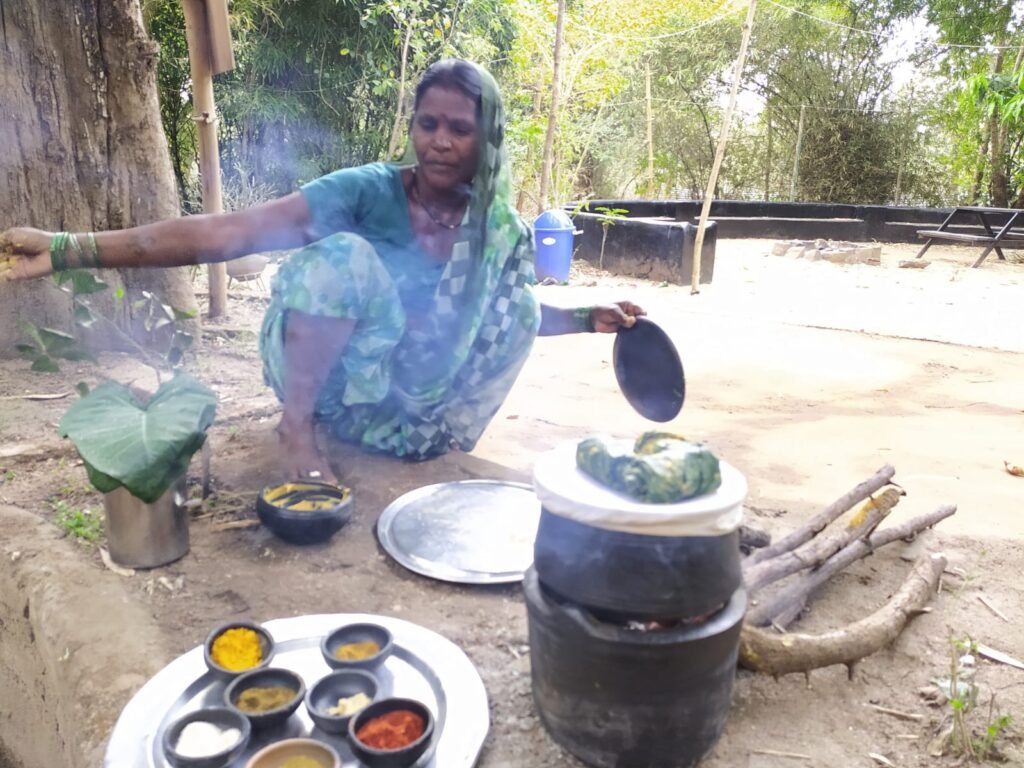
THE FOREST PANTRY LESSON
Alu leaves remind me that an ingredient is never just an ingredient.
Behind one green leaf is a story of seasonality, agriculture, regional identity, traditional cooking techniques and generations of culinary knowledge.
And behind those recipes are people.
People who have observed their surroundings closely.
People who have learned from previous generations.
People who know that the difference between an edible ingredient and an unsafe one can sometimes lie in a simple cooking technique passed down through generations.
That is what my interactions with tribal communities have made me appreciate most: food knowledge is often embedded in everyday life, rather than written down.
The next time you see a bundle of large green colocasia leaves, look beyond the familiar Patra.
Ask:
Where did they come from?
When were they harvested?
Which type are they?
How have local communities traditionally prepared them?
And most importantly:
What knowledge makes this ingredient safe and enjoyable to eat?
For me, that is where the real story of The Forest Pantry begins.
Not with a recipe.
But with a leaf, a landscape and the people who know it best.
